Ever wondered what really happens inside your smartphone once the screws come off? Whether you’re an aspiring technician or a DIY enthusiast, mastering mobile phone basics is the essential first step. From the complex layers of the LCD assembly to the intricate logic board, understanding how these components work together is the key to successful, professional repairs. In this guide, we’ll break down the core architecture of modern smartphones and give you the foundation you need to repair with confidence.
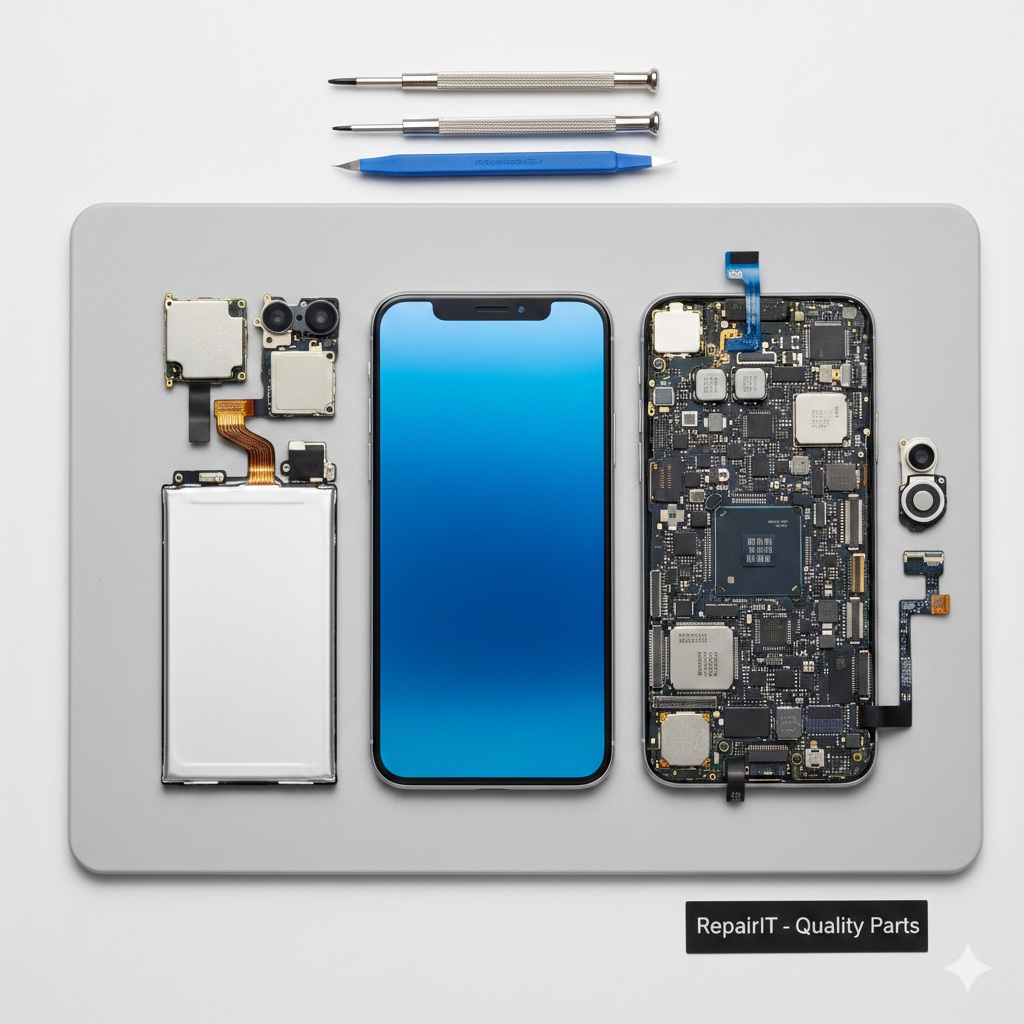
- Power supply part:
- Composition: The mobile phone power supply circuit is divided into two categories: logic voltage and radio frequency voltage. Thereinto:
The logic voltage is: 1.8V or 2.8V constant voltage.
The RF voltage is: 2.8V jump voltage.
- Function: The power supply part mainly puts the 3.6V battery voltage and provides the required working voltage according to the different requirements of the circuit.
- Logical audio part:
Mobile phone logic circuits are divided into audio processing circuits and logic control circuits (including human-machine interface circuits). Thereinto:
The audio circuit is divided into: call receiving circuit, phone sending circuit, headset (Bluetooth headset) sending and receiving circuit.
Logic control circuits (human-machine interface circuits) are divided into: keyboard scanning circuits, display circuit circuits, ring circuits, vibration circuits, backlight circuits, SIM cards, camera circuits, MP3/MP4 and other circuits.
- Function:
- Logical part of the function:
The logical part is the command and control center for all the components of the phone; All data processing and functional circuits for receiving and transmitting are controlled by it.
When transmitting, the sound is converted into a current signal and processed to form a four-way transmitting baseband signal.
When receiving, the received baseband signal is restored to analog audio in the audio, and then amplified to push the earpiece to emit sound.
- RF part:
The mobile phone RF circuit is composed of: receiving circuit, transmitting circuit, local oscillation circuit (local circuit, frequency synthesis circuit, frequency combination circuit, phase-locked loop circuit) and other circuits.
- Receiving circuit: convert the electromagnetic wave sent by the base station into a weak AC current signal for demodulation to obtain the receiving baseband signal.
- Transmitting circuit: the transmitting frequency signal modulated from the transmitted baseband information; After being amplified by the power amplifier, the antenna is converted into electromagnetic waves and radiated out.
- Local oscillation circuit: generate four local oscillator frequency signals without any information, and demodulate the received signal; The transmission baseband information is modulated and the emission phase is identified.
- Clock part:
- Composition: The clock in GSM mobile phone is: 32.768KHZ and 13MHZ.
- Function:
- 32.768KHZ Clock:
A time display is provided. And turn to the running clock when the phone is standby.
- Use the CPU as a running clock (tube boot);
- Send the local oscillator circuit as a frequency reference (tube signal).
- Flow chart of mobile phone composition:
- Block diagram of the whole mobile phone:
- Arrangement of mobile phone components:
- Identification of mobile phone components:
- The machine board is a multi-layer fiber plywood, with a total of four layers of circuits; The front is a keyboard board; The back is a logic board; The middle layer is the via line; The other floor is a public area.
- The board is generally divided into three parts, separated by a yellow public space; The top is the launch part; the middle part is the receiving and local oscillator part; At the bottom is the logical audio part.
- The antenna switch is near the antenna contact at the top of the board; Next to it is the power amplifier and power control (miscellaneous machines integrate the antenna switch and power amplifier, and some mobile phones do not have power control).
- The high-frequency filter is between the antenna switch and the intermediate frequency, which is a white-gold or white cube.
- The intermediate frequency is in the middle of the board, with a 13M or 26M crystal next to it, a high-frequency filter and VCO, and there are many small capacitors (or white tantalum capacitors).
- RX-VCO is next to the intermediate frequency, and the white body with a shielding cover is provided.
- TX-VCO is between the intermediate frequency and the power amplifier, and the volume is larger than that of RX-VCO.
- CPU, font library, and temporary storage at the lower end of the board, most of them have sealing, and there are few peripheral components next to them; Generally, the CPU is large in size, and the font library and scratch are rectangular.
- The power supply is at the lower end of the board, close to the SIM card holder; There are a lot of bulky capacitors next to it (most of them will have an electrolytic capacitor connected in parallel to the positive pole of the battery).
- At present, most mobile phones do not have independent audio, and they are integrated in the power supply or CPU.